
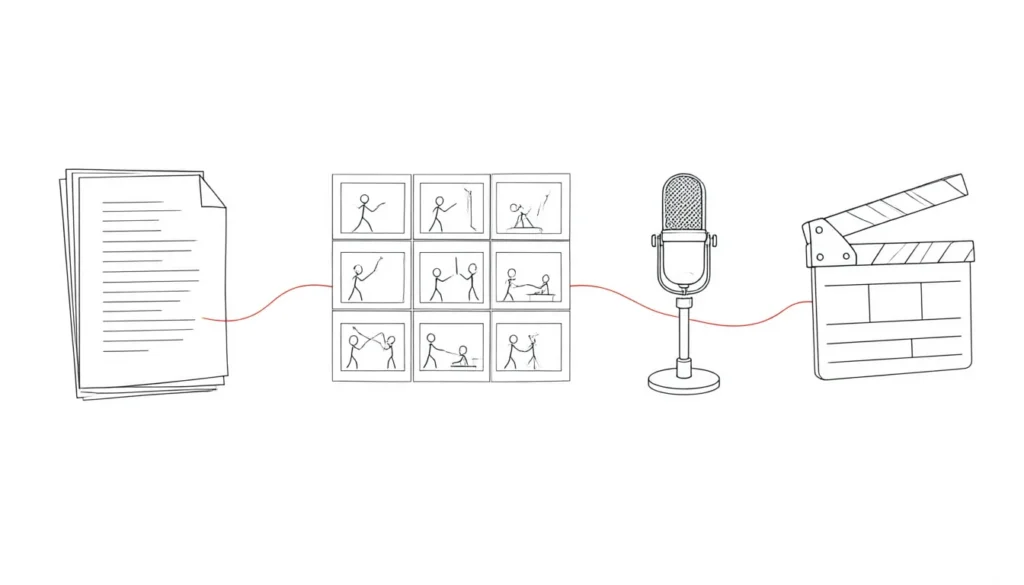
Most AI video tools stop at the clip. DramaClaw goes after the whole production line: feed it a manuscript or screenplay and it plans episodes, writes scripts, draws storyboards, generates shots, adds voice-over and cuts the result. The team behind it says it is the same pipeline they use to produce their own short dramas, released as source-available software you host yourself.
| Repository | dramaclaw/dramaclaw |
| Maintainer | DramaClaw team |
| Primary language | Python (FastAPI) with a React front end |
| GitHub stars | 5,695 (as of 15 September 2026) |
| Last push | 15 September 2026 |
| License status | Unverified — see below |
What it does
The README describes two interfaces sharing one asset library:
- XiaJi, the series pipeline: ingest a manuscript or screenplay (Fountain is supported), build episodes, characters and scenes, plan beats and multi-episode arcs, generate scripts with review-and-repair loops, create storyboards and first frames, synthesise voice-over, and export video with subtitles. Each stage is a separate task you can skip, resume or retry.
- XiaHua, the infinite canvas: a node workbench with 18 node types for image, video, audio, script, style and 3D work. Its “Director World” nodes turn an image into a 3D Gaussian-splat set or 360° panorama, so a location stays spatially consistent across shots.
A built-in agent, Xia Director, tracks project progress and drives pipeline tasks. The README says a local MCP server also exposes DramaClaw to Claude Code, Codex and other MCP clients. Agent-driven canvas building is listed as in development, not shipped.
Who it’s for
- Indie studios and creators producing serialised AI short dramas.
- Teams making ads or e-commerce product videos, which the README names as secondary uses.
- Developers who want to plug their own orchestration or agents into a video pipeline.
Getting started
DramaClaw itself does not run models. Per the README, all inference goes through an OpenAI-compatible gateway: either the maintainers’ hosted RelayClaw service or the bundled dramaclaw-gateway routed to providers you configure. The documented footprint is small: 2 vCPU and 4GB RAM recommended, no GPU for the standard pipeline (only the optional 3D “world” extra needs a CUDA GPU), running under Docker on macOS, Windows (Docker Desktop with WSL2) or Linux. Step-by-step setup is in the project’s Quick Start guide.
License status
Unverified. GitHub reports NOASSERTION for this repository, and the file it detected is a license-inventory.csv, not a license text, so its automated check tells us little. The README states: “DramaClaw is Elastic License 2.0,” and describes conditions including an attribution request and a restriction on offering it as a hosted SaaS. The Signal has not verified these terms against the repository’s actual license documents. Read them yourself before commercial use; the README points to issue #475 for the maintainers’ FAQ.
Limitations and open questions
- “Self-hosted” covers the app, not the AI: generation costs depend on the providers behind the gateway.
- The README’s comparison table against competitors is the maintainers’ own and masks competitor names.
- A young, fast-moving project (created March 2026, 75 open issues as of 15 September 2026); several screenshots are labelled as possibly differing from the current release.
- We have not deployed DramaClaw or produced anything with it.
Sources
- GitHub repository and README
- File detected by GitHub’s license check
- License FAQ (issue #475)
- dramaclaw.ai (project website)
Related: HunyuanVideo-1.5, an open video model you can run yourself · Video Generation.
This profile was drafted with AI assistance from the project’s public repository and reviewed by The Signal’s editors before publication. See our AI Disclosure.