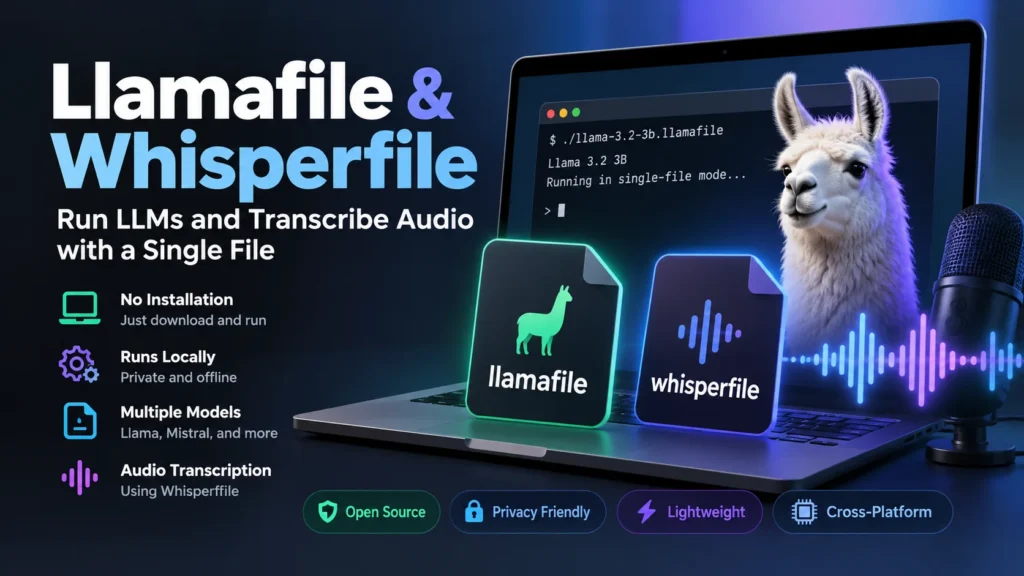
Running a local language model usually means installing a runtime, finding compatible weights and wiring them together. llamafile collapses all of that into one file: download it, mark it executable, run it. The project started under Mozilla Builders and is now maintained by Mozilla.ai.
Official downloads: use Mozilla.ai release assets and the setup documentation. For language models, start with llamafile; for speech transcription, look for whisperfile instructions and compatible Whisper weights. A runtime download does not necessarily include model weights.
| Repository | mozilla-ai/llamafile |
| Maintainer | Mozilla.ai |
| Primary language | C++ |
| GitHub stars | 25,970 (as of 15 September 2026) |
| Last push | 15 September 2026 |
| License status | Apache 2.0 software; model licenses are separate |
What it does
llamafile combines llama.cpp with Cosmopolitan Libc into a single-file executable, a “llamafile”, that the README says runs locally on most operating systems and CPU architectures with no installation. The same packaging powers whisperfile, a single-file speech-to-text tool built on whisper.cpp for transcribing and translating audio.
Versions from 0.10.0 onward use a new build system meant to track upstream llama.cpp more closely. The README says this adds support for newer models but may drop some older features; previous versions remain available from the releases page.
Whisperfile tiny English: official download and setup
Searching for whisper-tiny.en.llamafile? The current documentation calls the speech-to-text program whisperfile. Check the official Mozilla.ai releases and documentation first: historical filenames do not guarantee a ready-made executable with that exact name. Depending on the release, you may need the whisperfile executable and compatible Whisper tiny English model weights separately, or follow the official packaging guide to bundle them. Verify version-specific commands and avoid third-party executable mirrors.
For broader setup advice, see our local AI guide.
Who it’s for
- Anyone who wants to try an open LLM locally without setting up Python, CUDA or a model server.
- Developers distributing a model to users on mixed operating systems.
Getting started
The README’s quick start downloads a pre-built llamafile of Qwen3.5 0.8B (chosen as the smallest available, so the most likely to run anywhere), runs chmod +x on macOS, Linux or BSD, and executes it. On Windows, add a .exe extension first. Larger pre-built models are listed in the documentation for users with more powerful hardware or GPUs.
License status
Verified 17 October 2026: the repository LICENSE file identifies the llamafile software as Apache 2.0. Model weights packaged with it carry separate licenses; check the model card before redistributing or using a bundled model commercially.
Limitations and open questions
- On Windows, only executables under 4GB can run, so larger llamafiles won’t work directly. The README’s workaround is running the llamafile binary with external GGUF weights.
- The 0.10 rebuild may be missing features from earlier versions, per the maintainers.
- 214 open issues as of 15 September 2026.
- We have not benchmarked llamafile against other local runtimes.
For another local speech model, follow our Granite Speech 5.0 transcription tutorial. It includes a short CPU transcription test and an English-to-French translation example. Compare the documented language coverage and runtime requirements before choosing a model.
Sources
Related: Rapid-MLX, a local inference engine for Apple Silicon · Self-Hosting.
This profile was drafted with AI assistance from the project’s public repository and reviewed by The Signal’s editors before publication. See our AI Disclosure.