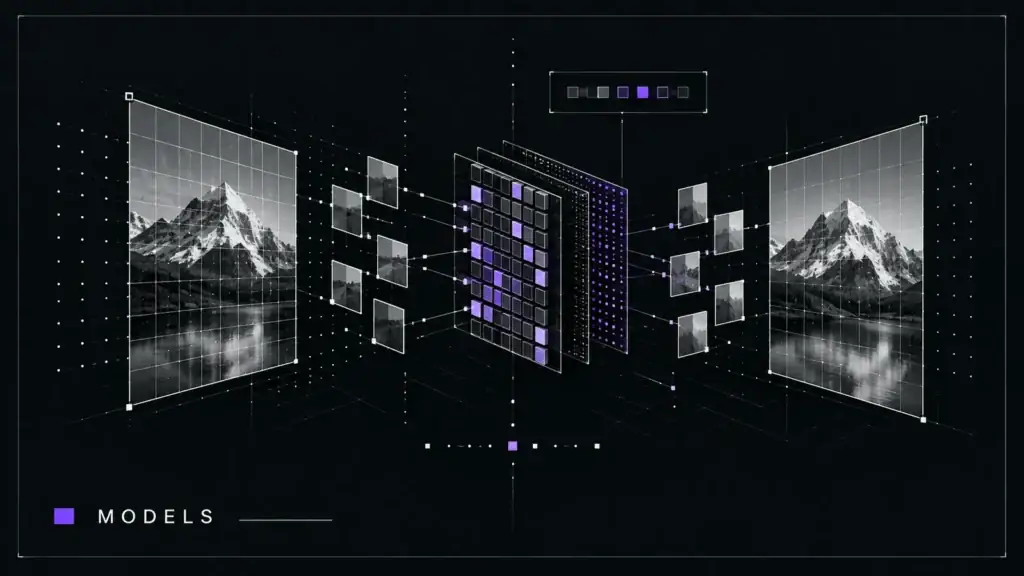
Every latent diffusion model depends on a visual tokenizer, the autoencoder that squeezes images into the compact latents the generator works with. VTP, a research project from Huazhong University of Science and Technology and MiniMax, asks what happens when you pre-train that tokenizer at scale the way you would a vision foundation model, and its answer is that generation gets better as the tokenizer grows.
| Repository | MiniMax-AI/VTP |
| Maintainer | MiniMax-AI (with Huazhong University of Science and Technology) |
| Primary language | Python |
| GitHub stars | 508 (as of 15 September 2026) |
| Last push | 15 April 2026 |
| License status | Unverified — see below |
What it does
According to the README, the team trained visual tokenizers from scratch by combining contrastive, self-supervised and reconstruction objectives. The project’s stated takeaways are:
- At the same compute budget for diffusion transformer training, scaling VTP gives better generation.
- Traditional autoencoders “CANNOT be scaled up” for diffusion models, in the authors’ words.
- Understanding, not just reconstruction, is the key driver of how well the tokenizer scales.
The resulting model is used three ways in the README’s example code: as an autoencoder (reported reconstruction rFID 0.36), as a CLIP-style image-text model (reported zero-shot accuracy 78.2), and as a self-supervised feature extractor (reported linear-probing accuracy 85.7). These are the authors’ numbers; see the technical report for the evaluation details.
Who it’s for
- Researchers building or training latent diffusion models who want an alternative tokenizer.
- Readers following where image-generation quality gains are coming from beyond the generator itself.
Getting started
The README’s quick start is pip install -r requirements.txt, then loading a checkpoint such as VTP-Large-f16d64 with VTPModel.from_pretrained. Its example preprocesses images to 256×256 and runs under CUDA autocast. Checkpoints are listed through the project’s Hugging Face collection. No hardware requirements are documented.
License status
Unverified. GitHub could not match this project’s license file to a standard open-source license (it reports NOASSERTION). The Signal has not reviewed the terms. Read the license file, and the licence shown on each Hugging Face checkpoint, before any commercial use or redistribution.
Limitations and open questions
- The README labels the project “Work still in Progress”.
- It is internally inconsistent about weights: the news section says pretrained weights were released on 16 December 2025, while the checkpoints section still says “Weights will be released very soon.”
- This is a component for model builders, not an end-user image generator.
- We have not reproduced any of the reported results.
Sources
- GitHub repository and README
- License file
- Technical report: Towards Scalable Pre-training of Visual Tokenizers for Generation (arXiv 2512.13687)
- Hugging Face collection
Related: Research · ReVersion, research on steering diffusion models.
This profile was drafted with AI assistance from the project’s public repository and reviewed by The Signal’s editors before publication. See our AI Disclosure.